
Grace, mercy, and peace be with all of you from God our Father and from our Lord and Savior, Jesus the Christ. Amen.
The problem with the world that we live in is identified in the third chapter of the Bible.
- The first chapter is God creating a beautiful universe and filling it with good things.
- The second chapter is the creation of human beings out of the dust of the earth.
- And then the third chapter, the first human beings are asked a question. “Did God really say? Did God really say not to eat from any of the trees in the garden?”
And Eve answers correctly, “No, silly. He didn’t say not to eat from any of the trees in the garden. He just said not to eat from that one tree in the middle of the garden. For in the day that we eat of it, we shall surely die.”
And then the tempter says this: “You will not surely die, for God knows that if you eat of it, you will become wise like God. You will know good from evil. Your eyes will be opened and you will be like God.”
And alas, they ate from this divine knowledge. And through that choice, they became what God knew they would become: moral agents, people able to choose right from wrong.
But also in exactly the same moment, their choice, of course, was against God’s word. And so therefore they chose evil and they fell. And therefore this problem that they have was passed down from generation to generation, having defied God, and the universe is falling apart.
We find ourselves on the receiving end of an inheritance that we would rather not have. For this problem is not just Adam’s problem, but it is my problem and yours too. We have inherited this sin problem.
It infects every aspect of our lives. Every place where we would strive to do what is righteous and good, it is tainted by sin. Therefore, it does not avail us the righteousness of God.
We are at war with ourselves. We were created to love and honor and obey God. But because of the fall of Man, we are no longer able to have divine righteousness. Our sin has separated us from a holy God.
And therefore, we see that manifested in our lives in two ways:
- We want things which we ought not have.
- And we are repelled by what we ought to do.
We have become like Adam and Eve in the garden. We are exposed! Adam and Eve were naked beforehand in the garden, but without law to show them their sin, they were unaware of their nakedness. But after they fall, they realize that they are exposed.
Critique of Modernism in the Church
Now, I was informed a few years ago by a so-called authority in the church that the preaching of law and gospel is outdated because modern people don’t feel shame and don’t believe in sin. And so instead, we pastors are to preach to people’s “felt needs.” And we need to become “seeker sensitive.”
And for a while, I’ll confess to you, my brothers and sisters, that I bought in to this approach to the church. And so I followed their plans.
And their plans included things like being inoffensive, offering practical advice, and constantly doing things which are new and interesting. Because when you have new and interesting things, hopefully people notice that and they show up and they want to come to church. We’ve got to get butts in the seats!
And I tried that for a while. And here’s what I learned:
- I learned that if you strive to be inoffensive, the people who start coming to church are the easily offended.
- If you strive to seek after practical advice seekers, you will only end up with fair-weather friends who agree with your advice.
- If you try to constantly chase novelty, you will be forced to put yourself in the position where you are constantly finding something new to provide, or otherwise they will get bored and leave.
It starts off feeling like a shortcut. And it works in the short term. But in the long term, there is no growth. It’s exhausting. And it doesn’t actually make Christian disciples for the long term.
I have concluded that our ancestors in the faith had a much better approach: Preach the word of God and let the Word do its work. But to do so, we must become people once again of Law and Gospel.
The Role of Law and Gospel
Law is the commandment of God, which crushes us because of our sin. The law is given to us how far we have fallen and how much we are in need of grace. The law is a mirror that holds up to us reality when we would rather believe otherwise.
Let me give you an example: Now, I know in my heart of hearts that on a scale of one to ten, I am so handsome, I am maybe a nine or a ten. But if somebody holds up a mirror to me right now, and I look at myself in the mirror, I am forced to confront the reality that I’m a four at best. Maybe a five with a good haircut.
The law shows me reality that I would deny from my own perspective. I have to be taught the law because I don’t want the law. I don’t want to look in the mirror. I’d rather believe that I am shiny and perfect and handsome and I’ve got a million dollar smile.
But then the law shows me what’s real. It shows me what’s true. I need something more than what I am.
And that’s when I come to the Gospel. The sweet grace of God! The forgiveness of sins through the cross of our Lord Jesus Christ! A grace which was not cheap, but very expensive — it cost our Lord Jesus His life.
That I am forgiven in spite of my great sin and my distance from God on account of this good news of the Gospel. That’s where we must begin. In fact, that’s where we must begin for any renewal in the church. Where we must begin for anything that seeks to gather new disciples into His kingdom.
How could they be so foolish?
So in this season of Lent, let us start first with Adam and Eve. Human beings created in a perfect universe, but somehow they fall. How could they be so stupid? How could they be so foolish?
They live in a perfect world. Literally a place without sin, without disease, without death, where every need is met for them. The weather is not 15 below outside with the wind chill. The weather is like a nice 68 all the time!
How could they be so stupid as to question that and to go beyond that? To say to God, “you know, you’ve said don’t eat from that tree. That’s the one thing I can’t do, but I don’t know. On the other hand, the serpent has a pretty good sales pitch.”
How did it happen? Satan appealed. To incrementalism. That’s what I’m going to call it.
Incrementalism is the idea not that you should become eeeevil, that you should become like on the cover of our bulletin today, you know, where Satan comes up and he’s like, you know, hey, you’d expect that Satan would not be the kind of person you want to listen to considering he has horns. That’s a giveaway.
Now, if the evil one ever shows up to you with horns, I mean, you know, don’t listen to him, but he doesn’t show up with horns. He shows up whispering platitudes about how it is not so bad. It is not so bad.
Satan appealed to incrementalism. “Well, if you can eat from any of these trees, what’s wrong with that tree? If you can do all of these things, then what’s wrong with that one thing? If this makes you happy and you might want that, why can’t you have it? If all of this world was made for your good, how can there be things that are off limits?”
People of God, incrementalism will be the spiritual death of billions of people. And it sounds like this:
-
I believe in God, but I don’t raise my children in the church. I want them to be free agents, to be able to make their own decisions. And so they can make whatever decision they want, and I will support and love them because they have freedom.
Don’t be surprised when your kids turn out to be godless.
-
I believe in God, and I believe that God is good, but I don’t bear to listen to his word on a regular basis. I don’t choose to receive his sacraments.
Well, then if that’s you, don’t be surprised when you fall into temptation and sin because you are neglecting the medicine of heaven. And besides, what is it exactly that you believe that makes you any different than a demon? Demons believe in God too, they’re just scared of him.
The Temptations of Jesus
The evil one comes to Jesus with an incremental temptation. He doesn’t say, become evil. He just simply says, why not avail yourself of one more thing than what God has said? Why not give in to one more step?
- You’re the son of God, and you’re hungry. Why not command this stone to become bread? It’s such a small use of your ability and power. Why not take advantage of it for your good? Why not quell the hunger in your stomach and do something that you can easily do, that’ll cost you nothing?
- You’re the son of God. You command legions of angels, don’t you? You have power and authority. Why not jump down and let them show how you are divine? (I’ll be honest with you. I don’t think that that’s the entire intention. I’ll talk about that a little bit later.) Why not use your power? You’re stuck up on top of a tall building. You got an angel elevator. Why don’t you use it?
- You’re the son of God, but let me show you how you can become the king of the world and become the king of the world quickly because all you have to do, says Satan, is bow down and worship me. And then you become king. I’ll give you the kingship. (Well, it’s not his to give.)
In all these things, Satan offers a shortcut, an incremental step in his direction. Why not use your power for your own convenience? Why not give a choice that gives in to temptation just a little bit? How could it be so bad?
You think it was hard for Jesus to turn away from the devil? I do. I think it tore at him. Imagine how hungry he must have been after forty days in the wilderness without a bite to eat. If you’ve skipped a meal or two, you know what it is to be hungry, but imagine what it is to be weak and famished and hunger is gnawing at you.
Imagine how easy it would have been to descend like a god from the top of the Temple and short-circuit all that dusty, dirty work preaching in Galilee. Can you imagine being a temple priest or scribe in the temple court and you saw a man suddenly appear on the top of the temple and then he jumped off and slowly glided like Superman down to the ground? And then he said, “I’m the Son of God!” Do you think you’d believe him? Of course you would. People would immediately believe him. They would say, “Wow, the Messiah has come, he came with a miracle and descended from the heavens!”
Imagine how much less painful it would have been to be declared king of the world without first being crucified on a Roman cross.
Shortcuts and Their Consequences
Here’s something universal: We all love shortcuts. We see that on social media all the time, don’t we? Life hacks. Productivity hacks. Ways to make your life just a little bit better.
I’ll be honest, the ones that I see on Instagram where it’s like, do this and try this little hack and it’s like, it’s always worse. But we love watching those videos because we like imagining that there are shortcuts that will make things better.
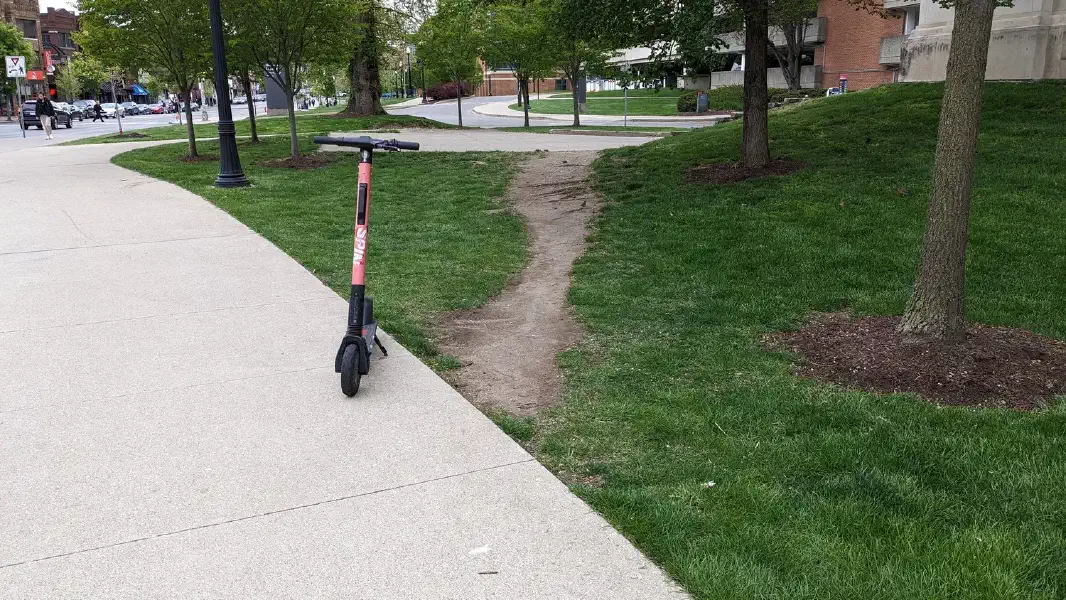
Or college campuses. I was recently on college visit with my daughter Anneliese. And you see these little paths through the grass, you know? Little places where the grass has been worn down flat.
You know what that is? That’s one student being in a hurry to get to class. And decides, you know what? I don’t want to walk all the way to that intersection, turn and go all the way that way. I’m going to, you know, I studied algebra. The hypotenuse is shorter. So I’m going to go that way across the grass.
And it tramples down the grass a little. And somebody else sees that student doing it and they follow. And a couple more people see that and they follow him. And pretty soon, the grass is a little different color because it’s been matted down.
And people see that as an option because other people have done it. And so why can’t I do it? And they begin to walk on the grass there. And pretty soon, that grass isn’t a different color. That grass is dead. And there’s a dirt spot there.
And if you’re a smart college groundskeeper, you pave it. Which is why the college campuses usually have strange diagonal sidewalks everywhere. They’re just paving where the college kids are going to walk anyway. Because everybody loves a shortcut!
But these little shortcuts have big consequences. Adam and Eve fell because they wanted a shortcut to be like God. And Satan offered it to them and they took it.
But on the other hand, Jesus intentionally chose the hard path.
For us today, there are two paths before us.
There is the easy path, which is to go with the cultural flow. The world which does not love your faith in Christ and would rather you gave it up in favor of pursuing your own self-interest:
- Let the schools and TikTok raise your kids and teach them what to think.
- Enjoy yourself as much as you can on the weekend.
- Don’t devote any time to the Lord because after all, you earned it.
- Find shortcuts.
- Get ahead.
- And hope later as you are on your deathbed that you look back on your life and somehow it feels worthwhile.
Or the hard path, which is to follow the Lord:
- Take responsibility for raising your own kids and grandkids with a biblical worldview.
- Set aside time on the weekend to worship the Lord.
- Do the long, hard work, especially in Lent, of examining yourself and repenting of your sin.
People of God, one of these paths leads to life and one of these paths leads to death. Adam and Eve took the easy shortcut and it led to death. Not just for them, but for all of us.
As Paul wrote in Romans 5 today:
Sin came into the world through one man and death came through sin. And so death spread to all because all have sinned. Sin was indeed in the world before the law, but sin is not reckoned when there is no law. Yet death exercised dominion from Adam to Moses, even over those whose sins were not like the transgression of Adam, who is a type of the one to come.
The easy path became a way of death for them. The easy path was actually far harder. And not just for them, but for all of us after them as well.
But Christ has taken the hard path and he has taken it for you. And it became a way of life, not just for him, but for you and me and all of us.
St. Paul puts it this way:
For if the many died through the one man’s trespass, much more surely have the grace of God and the free gift in the grace of the one man, Jesus Christ, abounded for the many.
So what will it be, Christian? Will you live by bread alone and die? Or will you live by every word that proceeds from the mouth of God?
Christ is calling you. He who took the hard road did so for you. He has finished the work of salvation for you. Trust and believe in the Lord and live for him alone that you may live in Jesus’ name. Amen.